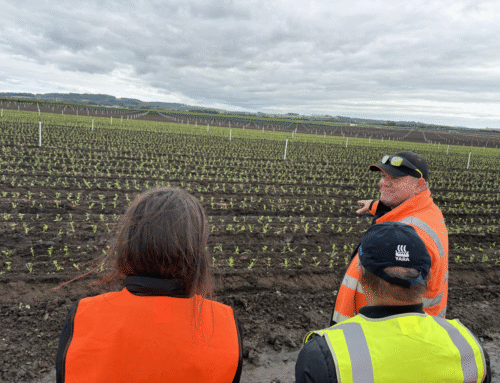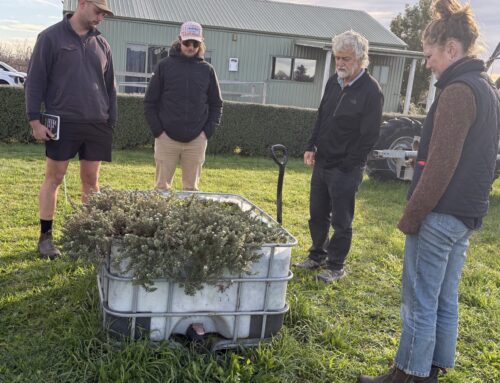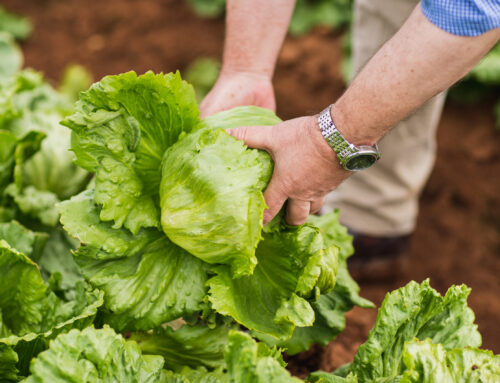
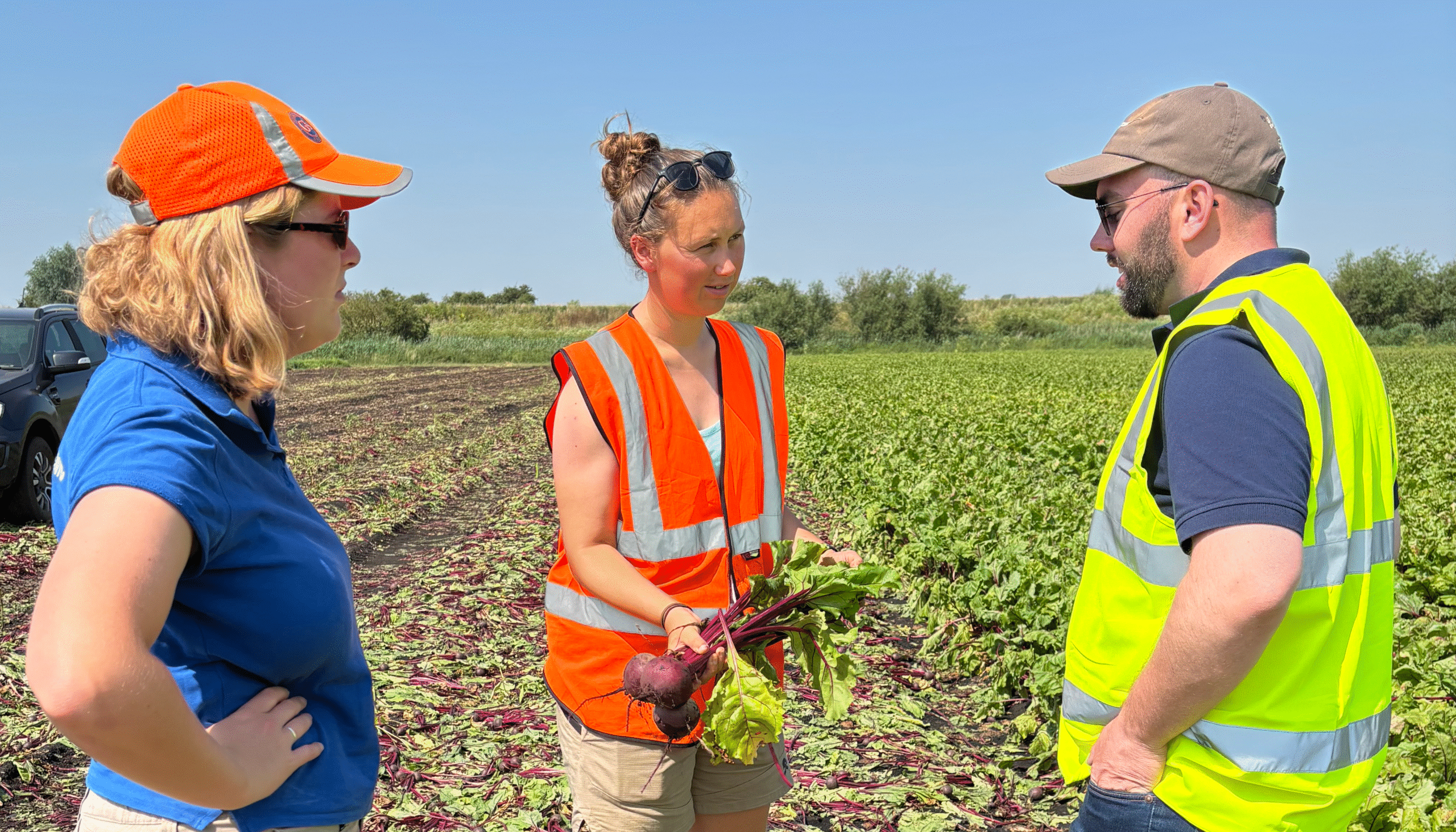
As part of a VegMech study tour in July 2026, Tayla Field (RMCG/VegNET Tasmania) and Dylan Bellchambers (Harvest Moon and Soil Wealth ICP Project Reference Group Member) travelled to the UK to explore new approaches to soil health and sustainable horticultural production. Among the highlights was a visit to G’s Fresh, a third-generation family-owned farming business cropping 17,500 hectares across the UK and Europe, with a goal to be farming regeneratively across all its properties by 2030.
Following a visit from the G’s Fresh team to Australia in late 2025, Tayla and Dylan reconnected with Lucy Harler (Future Farming Manager) and Megan-Rose Beard (Technical Agronomist for celery and organics), where the conversation turned to one of the farm’s most interesting sustainability initiatives: Johnson-Su compost.
Soil health at G’s Fresh is built around keeping living roots in the ground and pushing carbon through the root system to build soil biology, with a range of tools used to support that goal. Johnson-Su compost is one of the tools in the toolbox.
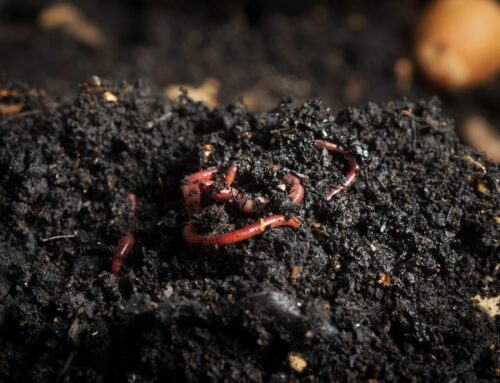
Johnson-Su is a compost that is an aerobic, low-turn, worm-rich compost that takes around 12 months to mature before an extract can be produced. It is relatively cheap to produce and can include a number of inputs that are common on farm.
Unlike conventional compost, the finished Johnson-Su material is used primarily as a biological inoculant, with the aim of supporting soil health, microbial activity and crop performance.
“What really stood out to me was that G’s isn’t seeing Johnson-Su as a silver bullet. They see it as another tool in the toolbox – something to incorporate into a broader approach to soil health,” Tayla said.
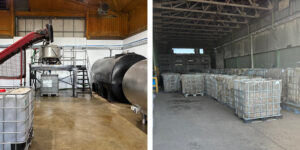
G’s Fresh is producing around 70 IBC containers of Johnson-Su twice per year and have custom-built a facility to scale up production for use on its own farms.
G’s is investing in infrastructure and equipment to produce around 800,000 litres of Johnson-Su inoculant each year across two batches in spring and summer, with each batch tested for Listeria and E. coli before use. The investment reflects the promise G’s is seeing in the approach. The farm is upgrading a shed and purchasing equipment to support production at scale, while continuing to investigate where and how the inoculant delivers the greatest benefit across its cropping systems.
The application method is tailored to the crop. For most crops, Johnson-Su is applied as a seed treatment at around 400L/ha. Onions, however, receive the treatment in-furrow at planting. The G’s team modified an existing planter to deliver the liquid extract directly into the furrow, at rates of around 1,200L/ha.
The team also observed reduced white rot pressure in onions at higher application rates, an encouraging result that is prompting further investigation.
“I think the really interesting part is how practical they’ve made it,” Tayla said.
“They’ve adapted the equipment and application method to fit their farming system, rather than trying to force one approach across every crop.”
For Tayla and Dylan, the experience at G’s Fresh offered a useful insight into how biological inputs are moving from the experimental stage towards practical, on-farm application.
“There’s still a lot to learn, but G’s are taking a really practical approach, trialling it, measuring the results and working out where it fits best. That’s what makes their experience so valuable for other growers looking at biological inputs.”
Integrated pest management in practice
G’s Fresh has a strong integrated pest management (IPM) approach, particularly in its organics and celery production, using a combination of banker plants, beneficial insects and habitat management to keep pest pressure down without relying solely on chemical controls.
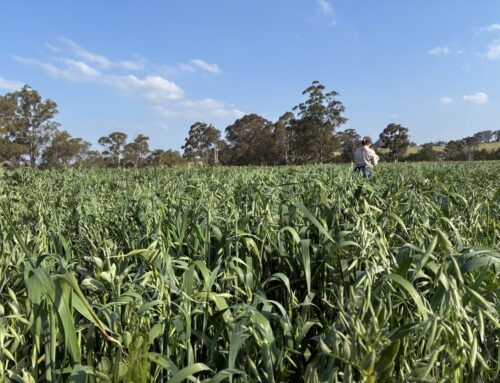
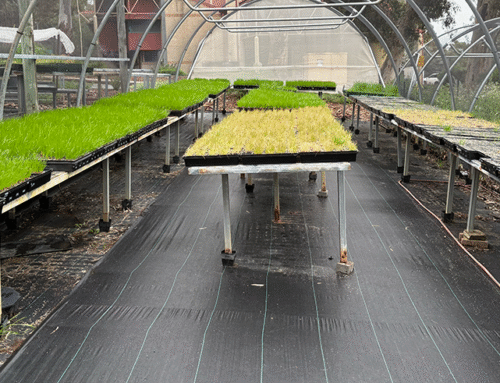
During the visit, Tayla and Dylan saw this in action with barley inoculated with grain aphids that have no interest in the vegetable crops nearby, to provide a food source for populations of beneficials such as ladybirds. Rather than continuing to buy insects at a significant cost, the team now breeds these populations of aphids in a central poly tunnel on barley grown in mushroom compost.
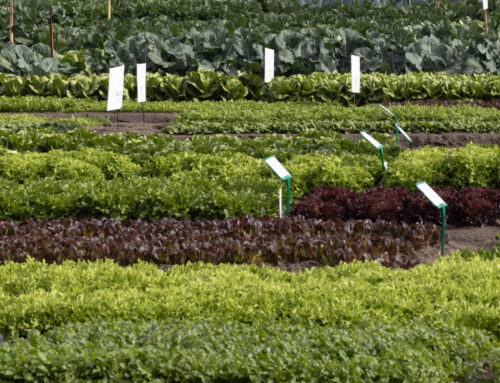
Smaller breeding populations are then taken from the central hoophouse and inoculated onto barley grown in hoophouses located in the paddock that house populations of beneficials such as ladybirds, hoverflies and lacewings. These are surrounded by field planted barley and the populations are released to the larger host crop that runs alongside the cash crop production. This approach provides an ongoing food source for beneficials and encouraging pest control activity in the cash crop.
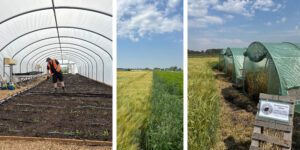
Centralised poly tunnel for breeding of grain aphids on a crop of barley grown in mushroom compost to maintain populations (left); host crop of barley and insectary planting strip followed by cash crop of celery (centre); and hoop houses located in the field to maintain beneficial predator cultures of ladybirds, lacewings and hoverflies (right).
Alyssum was planted between these tunnels, adding to the insectary flowering strips of alyssum, sunflowers and other crops such as phacelia spaced every 60 to 70 metres across the farm.
Around 22 percent of the organic production property is now dedicated to biodiversity, including wildlife corridors, ditches and headlands.
The G’s team is also trialling moveable insectary pods that Meg saw at the Te Ahikawariki Vegetable Industry Centre of Excellance in Pukekohe, New Zealand. The pods are designed simply and made out of IBC containers that are cut in half, filled with soil and planted with a mixture of beneficial attracting flowers. There are also insect hotels that have been added to the side of the pod. The pods are currently being independently assessed to identify the best species mix to plant.
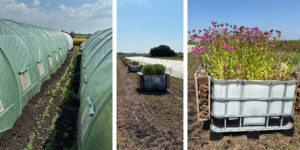
Recently planted Alyssum between polytunnels (left); and insectary pods and hotels on trial at G’s Group (centre and right).
The business continues to trial and refine regenerative tools across a wide range of crops, with plenty more R&D in the pipeline as start-ups approach the group with new technology to test. Thank you to Megan-Rose Beard and Lucy Harler, and the wider G’s Fresh team, for hosting the visit and sharing their journey towards farming regeneratively.