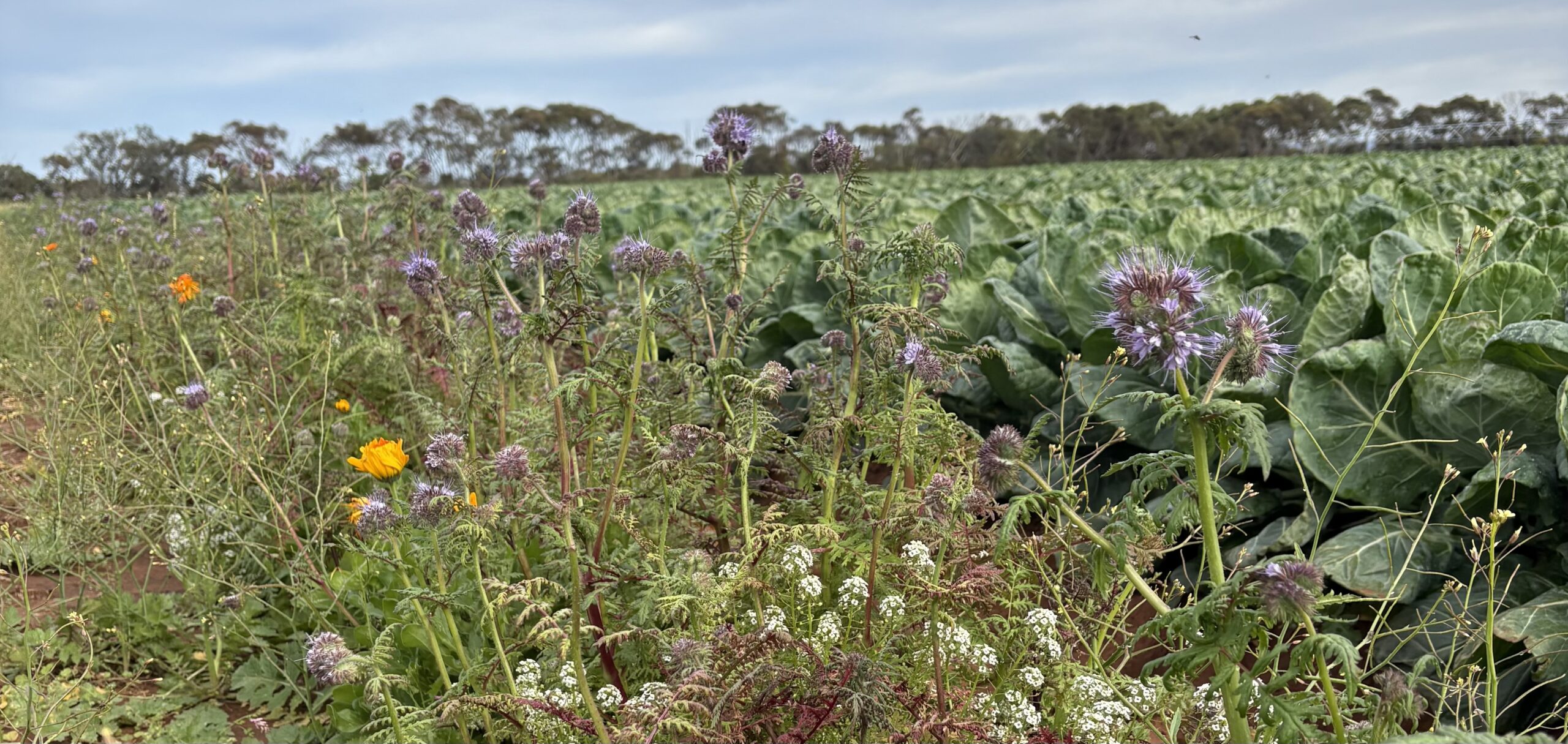
Josh and Erin Cranwell from AE Cranwell and Sons in South Australia have recently joined the Soil Wealth ICP demonstration site network. The sibling team have been trialling flowering borders for their Brussels sprout crop and are expanding their flowering strips to include native perennials.
The aim of the trial is to support beneficial insects in the crop to reduce pest pressure, with the highest pressure coming from Diamondback moths (DBM, Plutella xylostella). Cabbage aphids (Brevicoryne brassicae) can also be an issue in brassica crops.
Around their sprouts at Lake Plains, Josh and Erin have planted a range of flowering annuals, with phacelia, sweet alyssum and calendula the most successful to date. This builds on the farm’s wider integrated pest management (IPM) strategy, which includes regular crop scouting, releasing beneficial insects, spraying based on thresholds and using selective chemistries wherever possible.
While the flower boundaries have helped to bring beneficials into the crop and support those released, they are still affected when the crop is sprayed. Depending on the product that is sprayed, the residual action can kill beneficials re-entering the crop for weeks. To address this, an unused area between paddocks will be planted with more permanent flowering strips. One half will be dedicated to the annual flowering mix, and the other to native flowering perennials. These flowering strips will act as a reservoir for beneficials, allowing them to breed up and re-enter the crop once spraying is complete and residual action has reduced.
The annual flowering strip is expected to attract beneficials shortly after sowing, while the perennial native insectary is expected to attract beneficials within the first year of planting.
During the trial, we’ll be looking out for a range of naturally occurring beneficials in the environment that can help control DBM, including:
- Minute egg parasitoid wasps (Trichogramma)
- Small parasitoid wasps (Apanteles and Diadegma semiclausum, with Diadegma augmented by release)
- Brown lacewings and green lacewings
- Damsel bugs
While the main goal of the insectary strips is to attract DBM predators and parasitoids, they are expected to attract a wide range of beneficial insects that can help to suppress other brassica pests, many of which have already been observed in the crop. These generalists include:
- Ladybeetles (adults and larvae primarily predate on aphids)
- Nesidiocoris tenuis (a mirid that attacks a range of pests, including small caterpillars and moth eggs, aphids and thrips)
- Hoverflies (larvae primarily predate aphids, but will also attack caterpillars and mealybugs)
- Paper wasps (adults collect caterpillars and other soft-bodied insects to feed to their brood)
- Orchid dupe wasp (females parasitise noctuid moth caterpillars e.g. cutworms and armyworms)
This demonstration site is being delivered in partnership with Biological Services and Dr Bernardo O’Connor.