This article provides an update from the project Addressing herbicide resistance and control failures in ryegrass management for onions, carrots and rotational crops which is delivered by AUSVEG and funded by Hort Innovation using the vegetable and onion research and development levies and contributions from the Australian Government (Project MT25001).
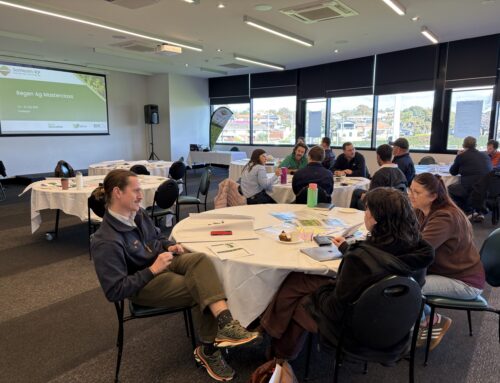
In late August 2026, the project team met in Adelaide with Dr Sam Kleeman to hear the latest updates on annual ryegrass (Lolium rigidum) resistance testing for onions and carrots and to discuss practical strategies to manage resistance on-farm.
The message is clear: Once herbicide resistance develops in a population, it doesn’t go away. With resistance spreading across Australian agriculture, protecting the herbicides we have is becoming increasingly important.
What are the trends?
Adelaide University is currently testing ryegrass samples from South Australian growers as part of the project. While the team was catching up on SA progress, the project is working to manage the issue nationally.
Across Australia, resistance to herbicide groups 1, 2, 3, 5, 9, 15 and 22 is now common for ryegrass. Alarmingly, one ryegrass plant out of every 20,000 will naturally be resistant to group 2 herbicides, and one in every million will be resistant to glyphosate. For context, ryegrass can set upwards of 2,000 seeds per plant, meaning only 10 plants setting seed are needed to produce a resistant plant in your population.
Resistance can spread rapidly across paddocks and farms. This is because ryegrass requires cross-pollination to set seed and disperses pollen by wind (travelling up to 5km). When populations of resistant ryegrass build, it can successfully outcompete crops for light, nutrients and water, reducing yield and posing potential contamination issues in harvested crops.
Managing resistance on-farm
There is no single solution to managing herbicide resistance. An integrated approach can help reduce the risk of resistance developing and slow its spread, helping to maintain access to important chemistries.
Key strategies include:
- Mix herbicide modes of action (MOAs). Applying two or more MOAs on ryegrass, either as a tank mix or in sequence, is one of the most effective resistance management tactics. Because plants surviving one herbicide are then exposed to a second, different MOA, overall selection pressure is reduced, and the chance of controlling ryegrass resistant to any single group is greatly improved.
- Rotate MOAs across the season and across years. Using different MOAs reduces selection pressure and increases the chance of controlling ryegrass resistant to one group.
- Use cultural and physical control strategies alongside herbicides, as part of an integrated weed management plan. This includes cleaning machinery between paddocks to reduce the spread, establishing crops early and promoting early vigour to outcompete ryegrass, and hand weeding or cultivating weeds.
- Optimise spray efficiency by ensuring your spray pump and nozzles are fully functional, spray pressure and droplet size are correct for the product, and tracker speed aligns with the label. This maximises coverage, increasing weed kill.
- Reduce the weed seed bank by preventing weed seed set, and germinating and terminating weeds prior to planting.
- Get suspected resistant plants tested. Lab testing is the best way to confirm the type of resistance (i.e. the active ingredients in herbicides to which the grass is resistant). Identifying the type of resistance early gives you an opportunity to change management before the population builds and spreads.
Get your ryegrass tested!
As part of the project, onion and carrot growers can get their ryegrass tested for resistance for free. However, places are limited, so get in quickly if you suspect resistance.
To organise seed testing as part of the project, or for questions about resistance, contact Dr Christopher Preston on 0488 404 120 or at Christopher.preston@adelaide.edu.au.
Sampling is simple, and when ryegrass is entering its reproductive phase, seed samples are best. Samples are best collected after a suspected failed herbicide application by walking the field in a W pattern and collecting an equal number of seed heads from each ryegrass plant encountered. You can also collect from headlands or fencelines. Collect seeds in a paper bag to prevent rot in transit.
Send samples to: Weed Management, School of Agriculture, Food & Wine, College of Science, Adelaide University, Waite Campus, Hartley Grove, Waite Road, Urrbrae SA 5064.
Useful resources for managing herbicide resistance
Fact sheet: Herbicide resistance: Managing the risk
Book: Integrated weed management for the Australian vegetable industry
Booklet: Farm biosecurity manual
Guidelines: Sampling for resistance testing
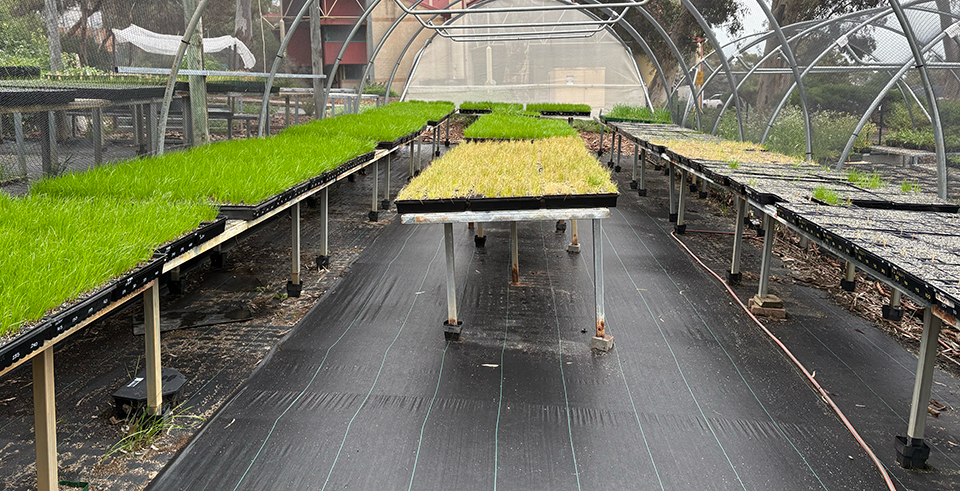
Image above: Ryegrass being tested for herbicide resistance at Adelaide University