Soil Wealth ICP team members recently gained insights into integrated pest management (IPM) and the use of insectaries in New Zealand, which play a strong role in regenerative agriculture practices for the vegetable industry.
During a study tour to New Zealand’s North Island, held as part of VegNET Tasmania’s Growing Regeneratively program, participants witnessed how these changes in IPM practices resulted from significant investment in research and extension from the industry-driven ‘A Lighter Touch’ program, which is now in its seventh and final year. To support the project, Plant and Food NZ invested $27 million in IPM approaches and novel biocontrol, as well as grower training and workshops, across all horticulture commodities in the country.
Two IPM practices were prominent throughout the region: Insectary pods and flowering strips. Both approaches aim to provide SNAP (Shelter, Nectar, Alternate prey and Pollen) to attract and retain beneficial predatory insect species. With beneficial insects in the production system, pest pressure decreases and pollination of fruiting crops can increase. The key is to ensure a full floral calendar, with insectaries flowering year-round (Figure 1).
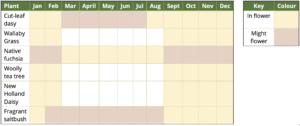
Figure 1: Example floral calendar for a native perennial flowering strip.
Grower adoption of insectaries is strong in New Zealand’s vegetable industry, with most of the farms visited during the study tour currently using or planning insectaries as part of their IPM program. Importantly, the benefits extend beyond the support of beneficial insects – one host grower noted an unexpected benefit for social licence: “Having sunflowers along our borders acts as a bit of marketing [as well as supporting beneficials]. Passersby see that and think, ‘Oh yeah, they’re doing good.’”
Ways to incorporate insectaries onto your vegetable farm
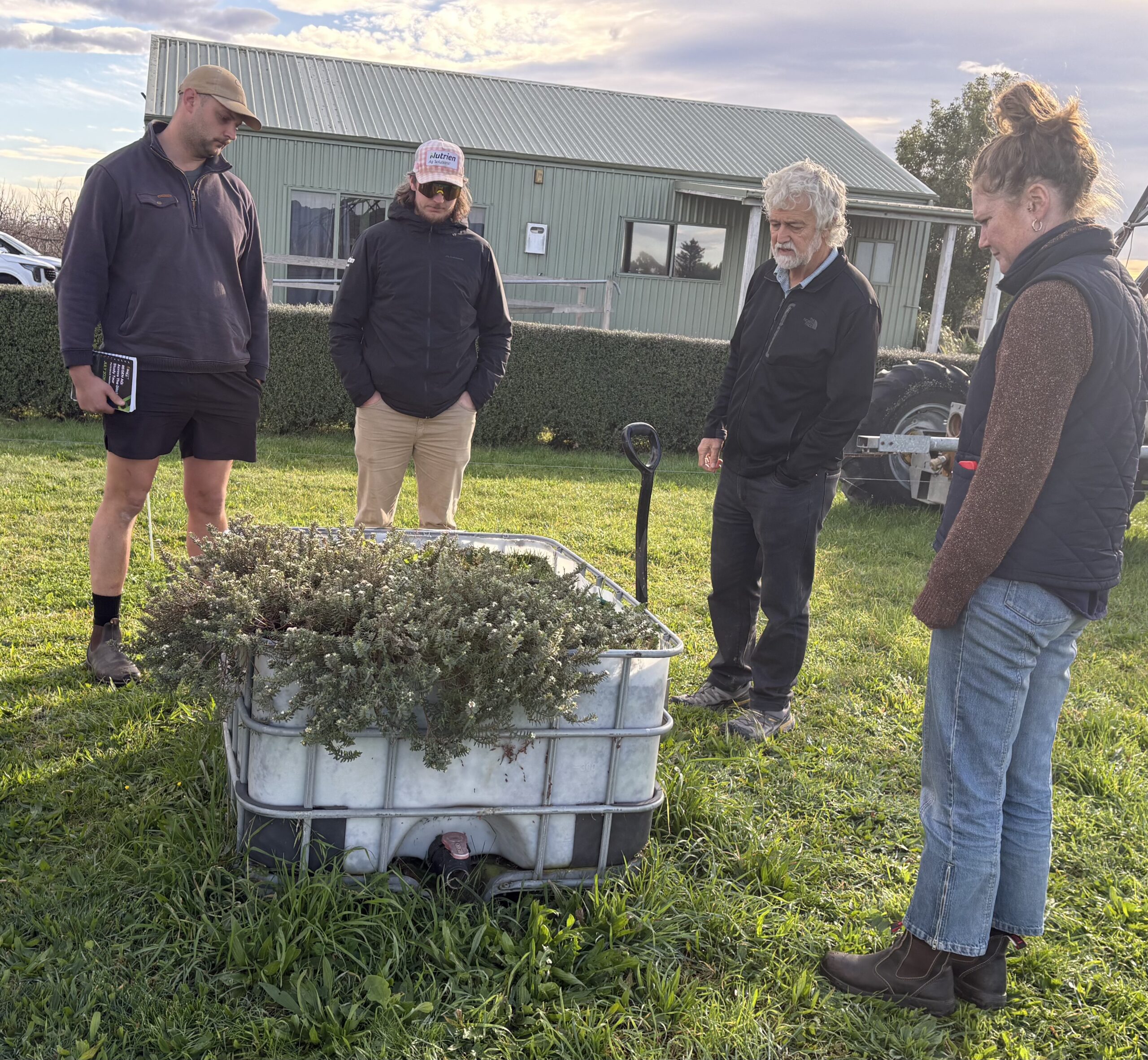
Insectary pods are 1000 litre pallet tanks (Intermediate Bulk Containers or IBCs) that are converted to self-wicking beds and planted with flowering plants, often perennial natives. The benefit of the pods is their mobility. Growers can move them around the farm and into a crop to attract beneficials where they are needed most, and offer the opportunity to trial the approach before committing to perennial plantings. However, the pods require watering, especially during summer heat (but can be placed under a pivot), and require ‘refreshing’ every couple of years as the growing media compacts and reduces healthy root growth.
At the Pukekohe Vegetable Research Farm in New Zealand, the Bioeconomy Science Institute (BSI) is currently assessing the pods, studying what beneficials they are hosting and finding the optimal plant species mix for the beneficials they want to attract. Further work is required in the Australian context to identify the ideal species for local production.
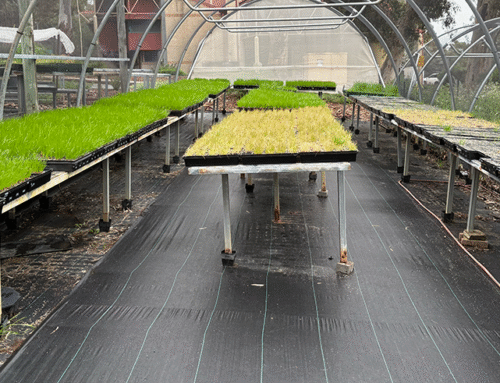
Flowering strips are strips of perennials or annual flowers that are planted along the edge of a paddock or on a sprinkler line. These strips can be direct sown or transplanted, depending on the area and plant species chosen. The Lighter Touch team implemented flowering strips with a range of plants native to the area, as they are evolutionarily adapted to local conditions and, once established, require minimal care.
On-farm research by A Lighter Touch, and supported by Dr Paul Horne (IPM Technologies), found that increasing beneficials in the production system (including ladybeetles, hoverflies, wasps and spiders) reduced pest pressure. These beneficials can travel up to 50m from the insectary plantings, meaning one strip or pod can go a long way.
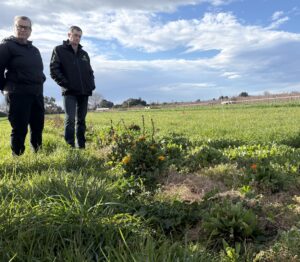
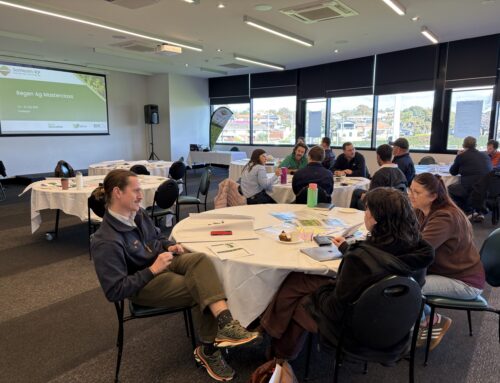
L-R: Seona Findlay and Coby Badcock inspect an annual flowering strip of sweet alyssum and calendula at the end of its life during the New Zealand study tour.
Learn more
- Article: Native insectary and banker plant trials underway at Braham Produce
- Case study: Banker plants in protected capsicums at Braham Produce
- Online training: Register for our free, self-paced IPM training course
- Webinar recording: IPM principles and practices
Header image: Tour participants with Dan Bloomer from Landwise inspecting an insectary pod. L-R: Ettienne de Kock, Jason Taylor, Dan Bloomer and Prue Rothwell.