
In late August, 2025 growers and agronomists from across New South Wales, Tasmania and Queensland took part in a two-day Soil Biology Masterclass in Camden, NSW presented by Soil Wealth ICP team members, Dr Kelvin Montagu (AHR), Dr Doris Blaesing (RMCG), Camilla Humphries (RMCG) and Stephanie Tabone (AHR).
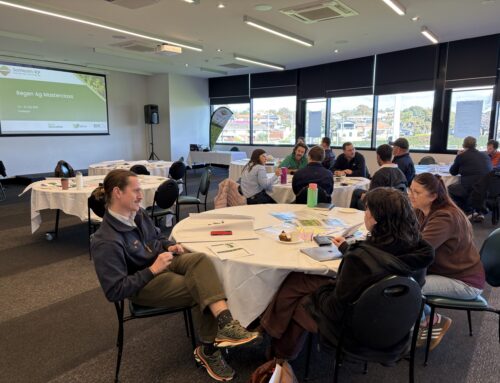
To get started, an interactive theory session on the building blocks of soil health helped unpack the complex interactions of soil biology, chemistry, and physics, the roles of soil microorganisms, and how soil biology underpins crop health and productivity.
Discussions followed on the management practices that enhance biology, for example rotations, cover crops and reduced tillage, and those practices that deplete it.
Nutrient cycling was another key focus, with participants learning how to calculate nitrogen availability from organic sources and cover crops, and how to balance crop nutrient demand with soil contributions.
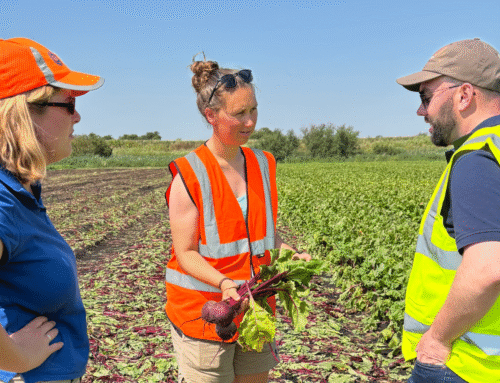
In the afternoon, the group travelled to Phil Bartolo’s farm for a field walk at the Soil Wealth ICP demonstration site. The trial paddock, now planted with cabbages, provided a practical backdrop to talk through nutrient cycling from legume and cereal cover crop residues.
Phil then ran a live demonstration of a cover crop termination method: roller crimping a faba bean/oat mix, and a bed preparation method: speed discing an adjacent paddock. The group discussed how these different approaches influence soil health, crop establishment and nutrient availability.
Day two shifted from the paddock perspectives to lab-based testing and in-field testing. Participants explored the tools available to monitor soil biology, DNA and enzyme activity testing, and how to interpret results for decision-making. The session on biological products prompted a robust discussion on what’s available, how products work, and what questions to ask before investing.
A highlight of the second day was the panel session, where growers and advisors including Brad Giggins, Richard Fairley and host grower Phil Bartolo shared their experiences of adopting soil health practices including the benefits they’ve seen, the challenges faced, and their tips for others starting out.
Masterclass coordinator and project leader Sophia Thach was delighted to see the level of participation and discussion.
“What I loved most was seeing how engaged everyone was – whether it was crunching through the science in the classroom or standing out in the paddock talking about cover crops,” she said.
“Participants were really open, asking great questions and sharing their own experiences, and that’s where the real value of these masterclasses comes through.”
The masterclass closed with a scenario planning activity. In groups, participants worked through real-life soil health challenges, identified opportunities to improve practices, and presented their strategies back to the room. This hands-on exercise helped bring together the principles from across the two days and gave attendees concrete ideas to take home.


From left to right: Outside classroom with presenters discussing cover crop species, benefits, what to look out for, termination methods and how to see the signs of biological life on root systems; Doris Blaesing introducing the topic of soil biology and soil health, setting the scene for the masterclass; grower Phil Bartolo demonstrating roller crimping termination method in a paddock of faba bean and oats.
Acknowledgements
A big thank you to host grower Phil Bartolo for welcoming the group onto his farm and sharing his experience first-hand, and to our panellists, Brad Giggins, Phil Bartolo and Richard Fairly.