During March and April 2026, the Soil Wealth ICP team worked with VegNET Regional Development Officers to deliver workshops with international soil specialist Joel Williams in Tasmania, South Australia and Queensland. Below is a recap of the key discussion points from each event.
Tasmania
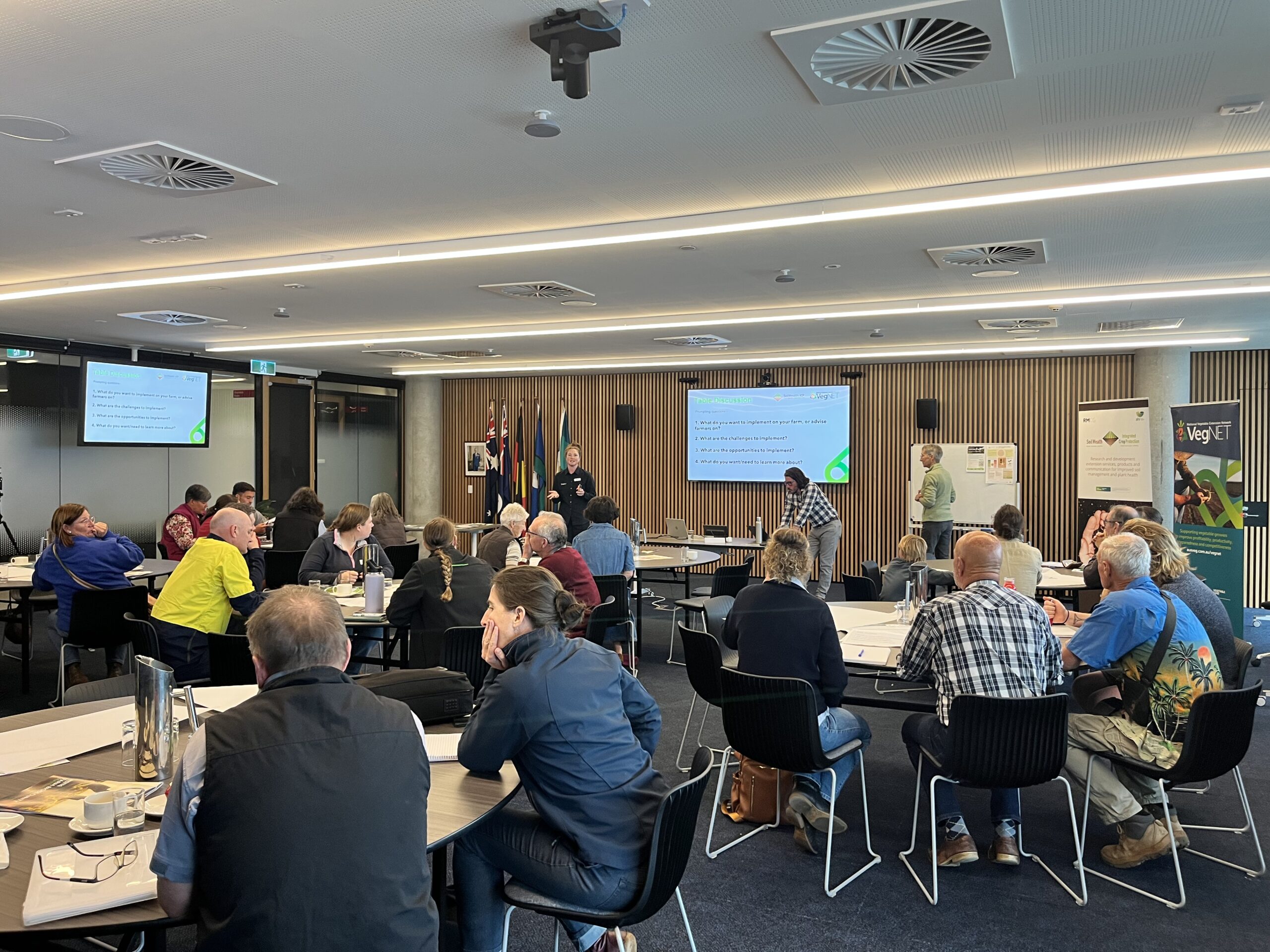
An industry event, delivered in collaboration between the Soil Wealth ICP project and VegNET Tasmania, brought growers and industry together for a full day of practical discussion with Joel Williams from Integrated Soils, as part of VegNET Tasmania’s Growing Regeneratively program. Topics spanned soil health, nutrient management, biological inputs, and how production systems can be redesigned for long-term resilience.
The day was framed around a simple but powerful idea: it’s not always about putting more on, but getting more out of what you already have. Joel introduced the ESR approach (Efficiency, Substitution and Redesign), as a practical progression for growers looking to improve how their systems perform over time. Key takeaways from the day are outlined below.
Efficiency
- Start with good information – soil tests, tissue and sap testing, and understanding crop nutrient removal helps growers make informed decisions on what products to apply, when and where.
- Don’t overlook spray water quality – salinity, pH above 6, and turbidity can all reduce the efficacy of foliar applied products before they’ve left the tank.
- Foliar feeding complements soil nutrition – applying nutrients directly to the leaf can be a faster, targeted response when root uptake is limited by soil conditions or weather.
- Organic matter is not one-size-fits-all – understanding the different types and how they function in the soil can help growers make better decisions about what to add and when, with flow-on benefits for soil life diversity, health and nutrient use efficiency.
Substitution
- Integrate a carbon source with nutrient applications – humic or fulvic acids can act as a ‘sponge’, binding to nutrients like phosphorous and trace metals to improve their availability to plants.
- Always look for the data behind new products – rather than taking claims at face value, ask questions and seek evidence before trialling something new.
- Seed treatments offer a targeted entry point for biology – introducing beneficial biology at the seed is a more precise approach than trying to shift the whole soil microbiome, and can support early root development and rhizosphere function.
Redesign
- Build diversity into the system – diverse crop rotations, multi-species cover crops, and diverse plantings in the broader landscape build resilience and support biological activity above and below ground.
- Plant diversity in the productive landscape matters – remnant bush, riparian plantings, windbreaks, and habitat for beneficial insects all contribute to a more resilient and self-sustaining system.
Roots and soil health
- Roots matter – healthy root systems in well-structured soils drive nutrient cycling, support microbial activity and reduce reliance on inputs. Crops with strong top growth but limited root systems tend to need more support through the season (e.g. irrigation, fertiliser).
- Soil compaction remains one of the biggest barriers – building root mass below ground is key to crop resilience, soil carbon and reducing irrigation and input needs.
No silver bullets – just practical ideas to test, adapt and apply on-farm.
The Growing Regeneratively program is funded by Hort Innovation using the vegetable and onion research and development levies and contributions from the Australian Government.
South Australia
Joel then headed to South Australia where he delivered a Soil Wealth ICP/VegNET SA workshop on soil health at the Adelaide Markets. Joel covered a range of topics on soil health, but what stood out was the importance of micronutrients in growing a quality, tasty crop free of pests and disease.
Missing micronutrients prevent the crop from turning nitrogen into the essential building blocks needed for growth, and accumulation of nitrates (NO3–) in the leaves can attract pests, weaken defence against disease, and develop a bitter taste.
Key takeaways
- Beat micronutrient deficiencies by doing regular crop tissue testing (sap or dry tissue).
- Micronutrient deficiencies can be addressed quickly with foliar applications and can overcome some soil conditions.
Queensland
The final stop was Mulgowie Farming Company in the Lockyer Valley, where around 20 growers, agronomists, advisors and industry representatives attended the Soil Wealth ICP/VegNET Southern Queensland workshop. Joel showcased regenerative practices, latest research and examples of alternative farming approaches adopted elsewhere around the world during his presentation.
A range of regenerative practices were discussed including:
- Minimising soil disturbance
- Maximising diversity of crops
- Keeping soil covered
- Keeping living roots in the soil
- Integrating livestock.
These regenerative practices have a diverse range of impacts, such as:
- Improving soil carbon
- Increasing microbial biomass
- Building soil fertility, leveraged in annual rotations
- Reducing disease and pests
- Stabilitising soil aggregates (building resilience to weather extremes)
- Moisture retention
- Improved soil structure
- Nutrient storage and cycling.
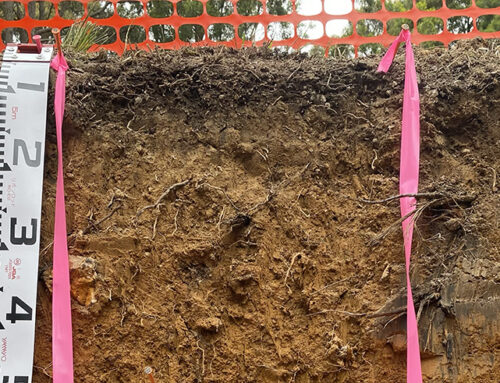
Joel reiterated the role of plant roots in improving soil biology and soil health. Plant roots change the biology, chemistry and physics of the surrounding soil and are more efficient at building soil organic matter than shoots, feeding soil biology through root exudates (liquid carbon).
He added that building carbon is not just about adding it, but also stabilising it (physically and chemically). This can be influenced by soil type and practices such as tillage, leaving the soil fallow, or adding compost and manure.
Joel shared how fertiliser efficiency can be improved through an integrated approach, with practices like:
- Applying the 4Rs (right time, right product, right rate, right place)
- Using nitrogen inhibitors to prevent nitrogen losses
- Leveraging biostimulants to encourage healthy soil biology, enabling a longer term, slower release of nutrients
- Ensuring other nutrients required for the nitrogen synthesis pathway are available to the plant
- Applying nitrogen in the form of amino acids allowing for metabolic shortcutting, saving the plant energy by not having to convert nitrogen into more complex forms and can also prevents nitrogen losses.
Regen ag in practice
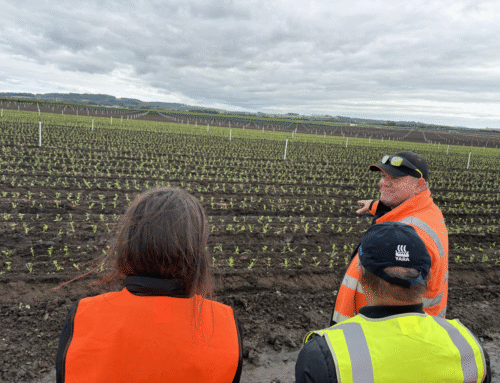
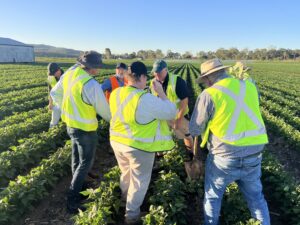
Following Joel’s presentation, attendees had an opportunity to get into the field and hear from the team at Mulgowie (pictured above) about their journey to adopting regenerative practices including controlled traffic, reduced tillage, direct drilling, growing cover crops, integrating livestock, compost application and their decision making process on whether to cultivate or not.
The team shared their strategies to improve nutrition, where testing has informed their decision making. This has led to a shift towards foliar fertiliser applications rather than a ‘more-on approach’, resulting in reduced fertiliser costs, and an increase average yields.
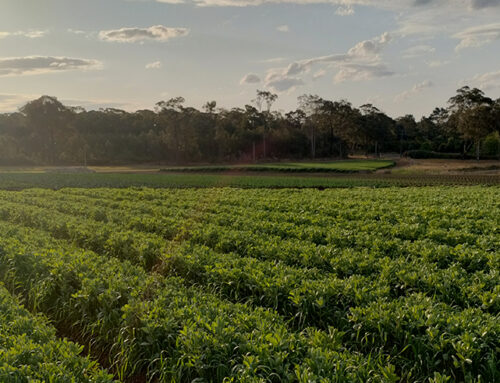
The farm has also faced challenges with flooding in recent years, with the team noting that soil health improvements have helped to build resilience to climate extremes and environmental stresses. Attendees could clearly see the results of Mulgowie’s efforts in a healthy crop of no till green beans which is on track to produce good yields.
“It was great to have Joel’s technical expertise on such a diverse array of topics. Joel brought latest research and practical examples from abroad, that could be considered at a local level,” Soil Wealth ICP team member Steph Tabone said.
“A big thanks to the Mulgowie team for hosting us in the field – it was highly relevant to hear and see how they had incorporated many of the improved practices that Joel discussed in the field.”
Key takeaways
- Grow more plants and embrace plant diversity (species, varieties, etc), and it will build healthy soil biology and bring many other beneficial soil functions
- Consider ways that diversity can be introduced into the cropping rotation, particularly in intense cropping systems – short cover crops, companion plantings and including livestock where possible and appropriate
- To improve nutrient efficiencies, get the basics right – right time, product, rate, place. Nitrogen is not an island; ensure the other relevant macro and micronutrients that are needed for nitrogen metabolism in the plant are also available. Application of amino acids are a way of shortcutting the metabolic pathway, reducing nitrogen losses and saving the plant energy and allowing it to withstand abiotic stresses.