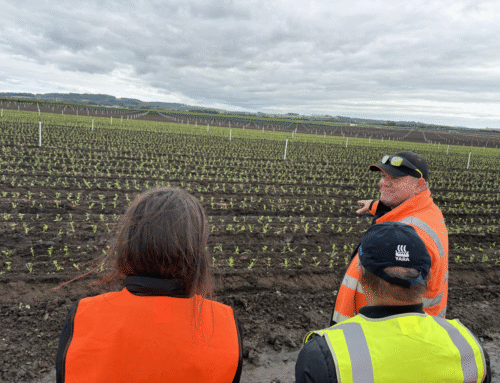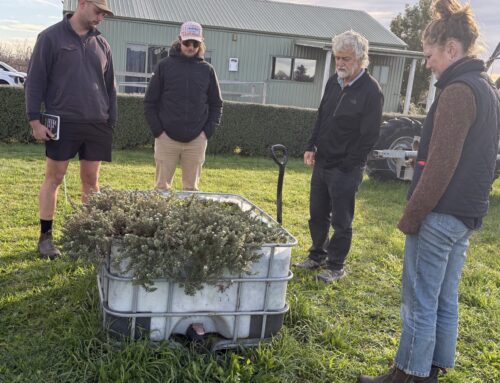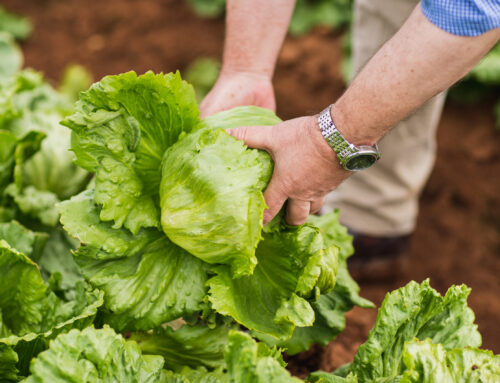

The Soil Wealth ICP team is working with Bowen growers Jess and Luke Volker to deliver a demonstration site focused on rebuilding soil health on a historically intensive vegetable farm in North Queensland.
The demo site in Bowen’s delta region has been continuously cropped for more than 50 years, predominantly tomatoes, followed by beans and corn.
Like many long-term vegetable production sites, the soil has experienced structural decline, reduced organic matter, and challenges with drainage.
Heavy rainfall events typical of Bowen’s tropical wet season have further highlighted poor infiltration and waterlogging in low-lying areas.
Having recently purchased the property and transitioning to certified organic production, Jess and Luke are keen to improve soil structure, drainage, microbial activity and overall soil resilience. This demonstration site provides an opportunity to measure and monitor practical strategies to support that transition.
The challenge
Soil testing has identified elevated magnesium and sodium levels, contributing to structural decline and sodicity. To address this imbalance, gypsum applications (approximately 1 t/ha) have been discussed to improve the calcium-to-magnesium ratio and support better soil aggregation. Improving infiltration is a priority, particularly during the summer rainfall period, to help flush salts below the root zone and reduce plant stress. Encouraging calcium movement through the profile is central to this strategy.
Fertiliser management and soil biology also present challenges. The current base fertiliser program relies on pelletised chicken manure; evidence of pellets not fully broken down suggests biological or environmental constraints to nutrient cycling. Ongoing soil biology monitoring will be important to track shifts in microbial activity as management changes are introduced.
Establishing cover crops over summer presents additional logistical and environmental challenges. High temperatures, burnout risk and limited staff availability can restrict timely sowing and management.
Trial objective and design
The primary objective is to improve soil nutrient balance and soil health using multi-species summer cover cropping.
The trial aims to improve soil structure, increase organic matter, enhance biological activity, suppress weeds and improve infiltration, ultimately supporting better crop performance and system resilience.
The demonstration (December 2025 – mid 2026) includes both a summer cover crop phase and a winter vegetable phase.
Summer 2025–26 cover crop phase
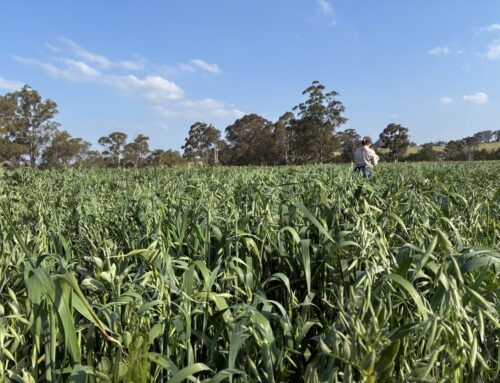
A multi-species cover crop mix (sorghum, sunn hemp, field radish and sunflower) was broadcast at 50 kg/ha across the trial area in December 2025 and will be terminated in late February/early March via rolling. A fallow control strip has been retained for comparison.
The cover crop was designed to:
- Rapidly establish ahead of the wet season
- Provide strong biomass production for soil cover
- Improve aggregate stability and infiltration
- Suppress weeds such as tick weed and bullheads
- Contribute nitrogen through legumes
Legume seed was inoculated prior to sowing, and 30 mm of rainfall was received immediately after planting, supporting establishment.
Winter 2026 vegetable phase
Following termination of the cover crop, reduced tillage approaches will be implemented before planting a winter vegetable crop. The aim is to retain cover crop benefits while minimising soil disturbance during bed preparation and plastic laying.
Data collection and monitoring
In-season assessments will focus on monitoring changes in soil, crop performance and overall system function throughout the trial. This will include soil nutrient testing and soil biology analysis, along with measurement of key soil health parameters such as infiltration, compaction and bulk density.
Cover crop biomass will be measured to quantify organic matter inputs and groundcover levels, while weed counts or weed pressure scoring will help assess the competitiveness of the cover crop system.
Regular crop health observations will also be undertaken to track plant vigour, potential nutrient deficiencies, disease presence and overall performance in response to the soil management practices.
Pre-harvest assessments will repeat soil nutrient, soil biology and soil physical measurements to evaluate changes over the season and identify improvements in soil structure and function.
At harvest, assessments will focus on crop quality and yield, including both marketable and unmarketable produce.
Looking ahead
The Soil Wealth ICP team will return to the site in March to carry out cover crop assessments and soil sampling prior to termination, and work with Jess and Luke to plan termination strategies and prepare the trial area for winter vegetable planting.
Updates, results, and key learnings from the site will be shared progressively through the Soil Wealth ICP website and industry communications channels.
More information
Please contact Sophia Thach, Applied Horticultural Research, 0413 937 313 or Sophia.thach@ahr.com.au
Acknowledgement
The Soil Wealth ICP team sincerely thanks Jess and Luke Volker for their openness, collaboration and willingness to trial new approaches on their farm.