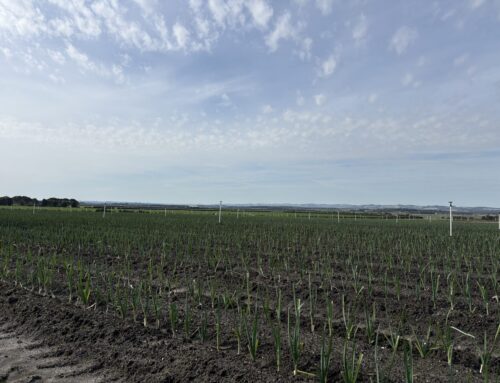

A new melon demonstration site in Ali Curung in central Australia is exploring how cover crops can be used alongside melons to build healthier soils, protect crops from wind damage, and make more efficient use of land between growing seasons.
Working with grower and host Paul McLaughlin from Desert Farms, the trial will introduce a rotational system where cover crops are planted on every second bed, while melons grow on the remaining beds. The alternating layout provides immediate wind protection for the melon crop, while the cover-cropped beds work to restore soil structure and fertility for the following season. In the next rotation, the arrangement will be reversed.
The grower’s standard practice is to use all beds during the cropping season, with sorghum windbreaks in between 5-bed bays, and then leave paddocks fallow for up to two years to manage pest and disease pressure. This new approach aims to reduce fallow time by maintaining soil cover, improving soil health and drainage, and supporting more sustainable production cycles.
The trial
The aim of this demonstration is to assess how cover crops influence soil health through leftover nutrient storage, organic matter improvements, erosion control and drainage. The team will also observe effects on crop health, particularly whether the system helps break disease cycles and reduce wind damage to young melon plants.
The Soil Wealth ICP project team from AHR will also assess the potential effect of the millet cover crop on weed pressure, pest and disease incidence, and the impact of wind protection on melon quality and yield. At the end of the trial, an economic analysis will compare the costs and benefits of introducing cover crops into melon rotations.
French white millet has been selected as the primary cover crop, sown on every second bed at a rate of 15kg/ha. An area without cover crop will be left as a control plot to help compare soil health, erosion and melon performance.
Soil and plant samples will be collected throughout the project for nutrient analysis, soil organic matter and microbial activity.
Field measurements – including soil compaction, water infiltration, aggregation and erosion – will help track physical changes over time.
The demonstration will run over two years to 2027.